
Most used car dealership marketing advice is written for franchise stores with an agency on retainer. An independent lot needs something different: ideas that cost little, fit around a busy week, and put the vehicles you already have in front of people who are already shopping.
These twelve ideas are grouped by where shoppers find you. None of them require a new budget to start. Pick two or three, do them well this week, and add more once they become habit.
Make every vehicle ad do more
1. Lead with a complete listing
Every ad you run points back to a listing. If that listing has six photos and “Runs great, call for details,” the ad is working against you.
Before you spend a dollar promoting a vehicle, make sure its listing has:
- Twenty or more photos in good light, starting with a clean front three-quarter shot.
- The details shoppers filter by: trim, drivetrain, mileage, engine, and the features that set this one apart.
- A short description written for a person, not a list of option codes. Say who the vehicle suits and why.
- A price, or a clear reason there isn’t one.
Start with the five vehicles you most want to move this month. Fixing five listings is a realistic afternoon.
2. Brand your photos so they’re recognizable in a feed
Shoppers scrolling Facebook or a marketplace see dozens of nearly identical silver SUVs. A consistent photo overlay with your logo and colors helps your inventory read as yours before anyone sees the dealership name.
Keep it small and clean. A slim bar with your logo works better than a frame that crowds the vehicle. Dealer Shock builds custom photo overlays for each dealership so every inventory image carries the same look.
3. Run inventory ads, not only brand ads
There are two kinds of dealership ads, and most lots need both:
- Creative ads tell your dealership’s story: who you are, how you treat people, what kind of vehicles you specialize in.
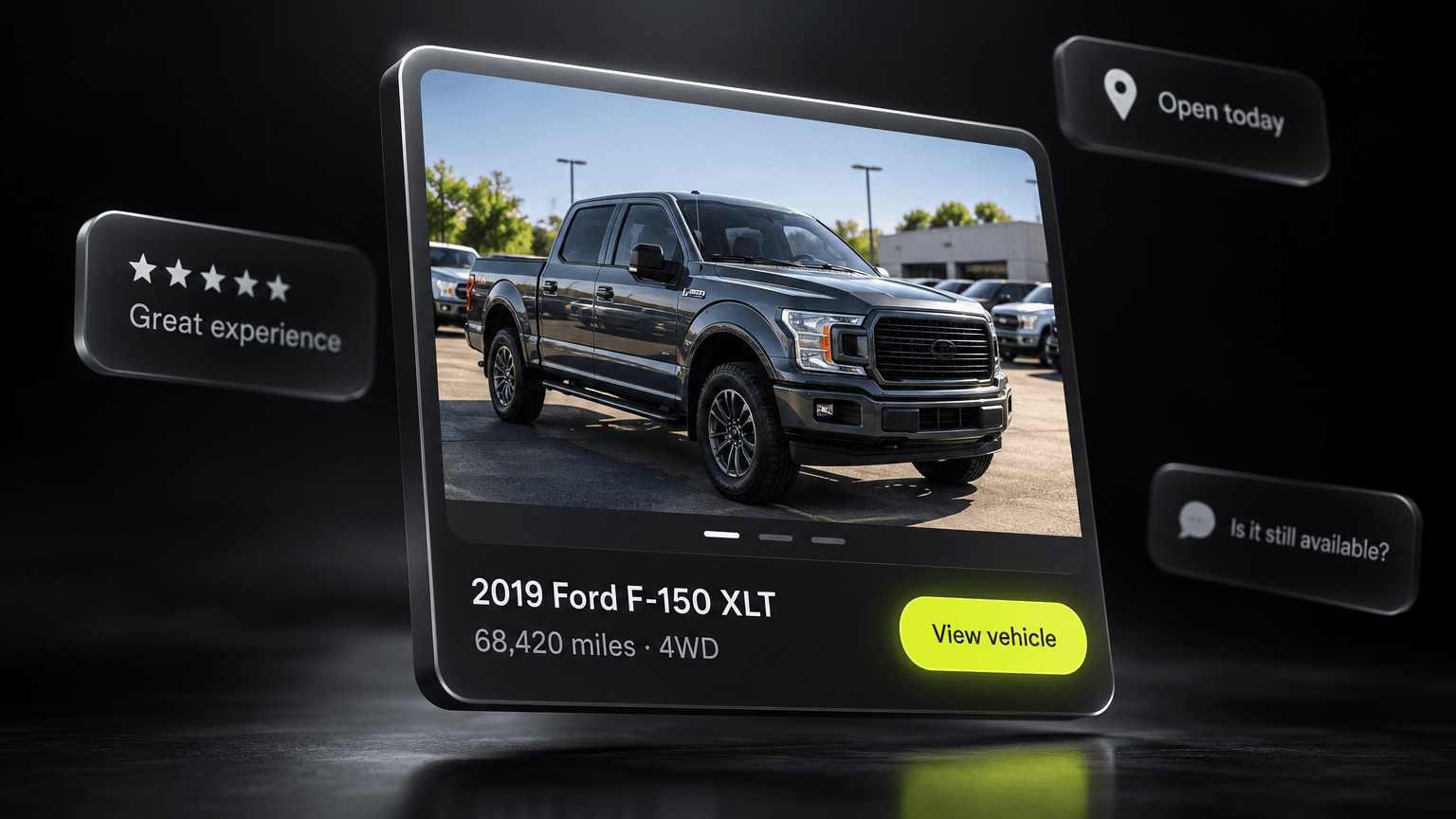
- Inventory ads show a specific vehicle with its photo, year, make, model, and details.
Creative ads build familiarity. Inventory ads catch the person who is ready to buy a 2018 F-150 this weekend. If you only run one kind, try a small test of the other. Match the inventory you promote to what actually sells in your market, and pull vehicles from your ads the day they sell.
If you’d rather not manage campaigns yourself, Dealer Shock Managed Advertising plans and runs creative and inventory ads on Facebook, Instagram, and Google around your market and budget.
Own your local search results
4. Treat your Google Business Profile like a second website
For many shoppers, your Google Business Profile is the first thing they see, before your website and before they ever call. It’s free, and most independent dealers leave it half finished.
This week:
- Check your hours, phone number, and website link. Wrong hours on a Saturday lose real customers.
- Pick the right categories. “Used car dealer” as the primary category, with secondary categories only where they’re true, such as “Car finance and loan company” if you offer in-house financing.
- Add fresh photos: your lot, your building from the street, your team, and a few current vehicles. Shoppers want to know what they’re driving up to.
- Post an update. A new arrival, a weekend special, or a note about financing. Posts are a simple way to show the profile is cared for.
- Answer the questions in the Q&A section yourself, before someone else answers them for you.
5. Ask for reviews at the moment of delivery
The best time to ask for a review is when the customer is holding the keys and smiling. A week later, the moment has passed.
Make it easy:
- Create a short review link from your Google Business Profile and put it on a card, in your delivery text message, and on the bottom of your email signature.
- Ask by name. “Would you mind sharing how today went? It really helps a small lot like ours” works better than a generic request.
- Reply to every review, good or bad. Keep negative replies calm, specific, and short, and offer to continue the conversation offline. Future shoppers read your replies as closely as the reviews.
Steady reviews over many months look more trustworthy than a burst of twenty in one week, so make asking part of every delivery instead of a campaign.
6. Give nearby towns a reason to find you
Most shoppers don’t search for your dealership by name. They search for a vehicle, a need, and a place: “used trucks near me,” “buy here pay here” plus their town, “used SUVs” plus the county.
Your website can meet those searches with pages about the vehicles and financing you offer in the communities you actually serve. Write about what’s true for each area, such as the distance to your lot, the vehicles people there tend to buy, and your financing options. Don’t copy and paste the same page with a different town name.
Dealer Shock’s Local Reach Pages build out those pages for you, so expanding into nearby searches doesn’t become another writing project.
Show up where buyers already browse
7. List on Facebook Marketplace and answer fast
Plenty of local used car shoppers start on Facebook Marketplace, often before they look at a dealer website. Treat it as a storefront:
- Use the same photos and descriptions as your website so the vehicle looks the same everywhere.
- Answer messages quickly. A shopper who messages three sellers about similar trucks often goes with whoever replies first.
- Move the conversation forward. Offer a time to see the vehicle, a link to the full listing, or a quick call, rather than answering the price question and stopping there.
- Remove sold vehicles promptly. Few things erode trust faster than “Sorry, that one’s gone.”
Keeping every destination current by hand gets old fast. Dealer Shock can export your inventory to the marketplaces and advertising providers you use, so photos, descriptions, and details stay in sync from one place.
8. Post every new arrival to your own pages
Your Facebook and Instagram followers include past customers, their friends, and people who already like your lot. A new arrival post costs nothing and keeps you in their feed.
Keep a simple rhythm: one post per new arrival, with the best photo, the year, make, and model, and one sentence about what makes it worth a look. Dealer Shock can create automatic social posts from your branded vehicle photos and listing details, so this doesn’t become another daily task.
Use video to answer questions before they’re asked
9. Film a 60-second walkaround on your phone
A walkaround video answers questions photos can’t: how the engine sounds at startup, how clean the interior really is, whether that scratch is as small as you say.
You don’t need equipment. A phone held horizontally, a quiet moment on the lot, and a simple order work well:
- Start at the front corner and introduce the vehicle by year, make, model, and mileage.
- Walk around slowly and point out anything a shopper would notice, including small flaws.
- Open the driver’s door, start it up, and show the dash with no warning lights.
- Show the back seat and cargo space.
- Finish with how to reach you.
Post it to the listing, Facebook, Instagram, YouTube, and Marketplace. Film your highest-interest vehicles first.
10. Send personal videos to serious shoppers
When someone asks about a specific vehicle, a 30-second video recorded just for them stands out from every other “Yes, it’s still available” reply. Say their name, show the vehicle they asked about, and answer their question on camera. It takes a minute and makes the conversation personal.
Follow up like the sale depends on it
11. Respond to every lead the same day, with context
A slow or generic reply undoes everything the marketing above accomplished. Set two simple rules this week:
- Every lead gets a real reply the same day, from a named person.
- Every reply references what the shopper actually did: the vehicle they asked about, the trade-in they described, the payment they asked about.
Context is easier when your inquiries live in one place. Dealer Shock lead management groups finance applications, test drive requests, trade-ins, and vehicle inquiries by contact, lets you assign each contact to someone on your team, and shows which vehicles a shopper viewed before they reached out.
12. Recover the shoppers who almost reached out
Some of your most interested shoppers never finish the form. They start a finance application, enter their name and phone number, then get interrupted.
Those are worth a polite, helpful follow-up: “I saw you were looking at the Tacoma. Happy to answer questions or pick up the application whenever you’re ready.” Dealer Shock keeps the contact details and vehicle of interest from an unfinished finance application as a standard lead, so your team can follow up instead of losing them.
Turn these ideas into a weekly routine
The best car dealership marketing strategies are the ones you keep doing. A realistic week for a small lot might look like this:
- Monday: Fix the listings for your five priority vehicles and refresh your Google Business Profile.
- Tuesday: Film walkarounds for two or three of those vehicles.
- Wednesday: Post new arrivals and check that Marketplace listings match your inventory.
- Thursday: Review your ads. Pause vehicles that sold and add the ones getting the most views.
- Friday: Reply to every review from the week and follow up on any lead without a next step.
- Every delivery: Ask for a review before the customer drives off.
Start small, measure what brings people to your lot, and drop what doesn’t. If you want help with the parts that take the most time, see how Managed Advertising and the AI Dealer Site bring your ads, inventory, and leads together.
Keep reading
- Facebook Marketplace for car dealers: what’s allowed now
- Car dealership SEO: a guide for independent dealers
- Car dealership lead generation: a guide for independent dealers
- Car dealership social media: 25 post ideas for independent dealers
- Google Business Profile for car dealers: a setup and local SEO guide
- How to start a used car dealership: a step-by-step guide