
Most dealership social media looks the same: a stock photo, “Stop in today!”, and a phone number. Then nobody posts for three weeks. It isn’t that dealers don’t care. It’s that posting falls to whoever has a spare minute, and nobody does.
The good news is that a small lot doesn’t need a content team. You already have the raw material: vehicles that change every week, people shoppers want to meet, and customers who are happy to drive off in something new. This guide covers where to post, 25 ideas that work for independent dealers, a weekly rhythm you can actually keep, and the rules that apply when a post mentions price or financing.
Where car shoppers are on social media
Pew Research Center’s 2025 survey found that 84% of US adults use YouTube, 71% use Facebook, 50% use Instagram, and 37% use TikTok. (Pew Research Center)
For most independent dealers, that points to a simple order:
- Facebook first. It’s where your local community already is, and it’s where shoppers check whether your dealership is real and active.
- Instagram second. The same photos and short videos work here with little extra effort.
- YouTube for walkarounds. Longer videos live well here, and YouTube Shorts can now run up to three minutes. (YouTube Help)
- TikTok if someone on your team enjoys it. A salesperson who likes being on camera can do more here than a forced corporate account.
It’s better to post steadily on two platforms than now and then on five.
25 car dealership social media post ideas
Show the inventory
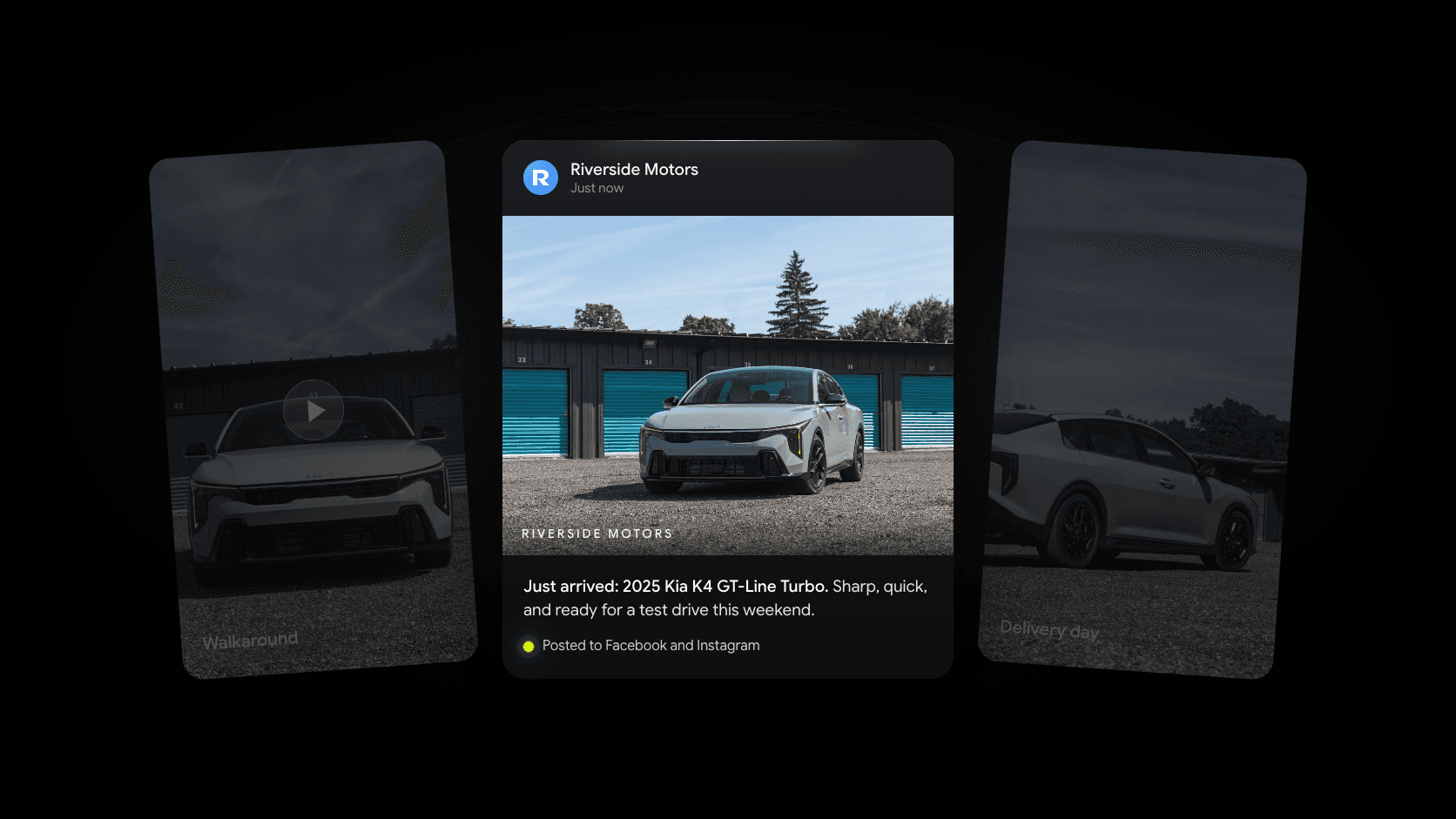
- New arrivals. One post per vehicle, with your best photo, the year, make, and model, and one sentence on what makes it worth a look.
- A 60-second walkaround. Start at the front corner, walk around slowly, start it up, and show the interior. Point out small flaws too. It builds trust.
- “Just traded in.” Post vehicles before they’re reconditioned and listed, so followers get a first look.
- Theme roundups. “Five trucks that can tow a camper,” “three first cars for a new driver,” or “AWD for winter.” Link to each vehicle page.
- The detail shot. One close-up of a feature people overlook, like a heated steering wheel or a third-row seat that actually fits adults.
- Before and after reconditioning. A dull headlight next to a restored one, or an interior before and after detailing.
- Sold. A simple “this one found a home” post shows your inventory moves and nudges people who were thinking about it to look sooner.
Introduce your people
- Meet the team. One person per post: their name, how long they’ve been with you, and what they drive.
- A day on the lot. Opening the gates, the morning wash line, the afternoon rush.
- Your service or recon shop. Show the people who inspect and prep your vehicles. Shoppers buying used care about this.
- Owner’s note. A short video from the owner on why the dealership exists and how you treat customers.
Celebrate customers
- Delivery day photos. A happy buyer with the keys is the most persuasive post a dealer can make. Always ask first, and only post customers who say yes.
- First car moments. Teenagers and their parents picking up a first car get shared widely by family and friends.
- Repeat buyers. “Third vehicle from us” says more than any slogan.
- Share real reviews. Turn a recent review into a simple graphic, with the customer’s permission.
Be useful
- Answer one common question. “Can I buy a car with bad credit?” “What do I need to bring?” “Do you take trades?” One question per post.
- Explain your process. What happens from the first message to driving away, step by step.
- Explain a term. What a vehicle history report shows, what “as is” means, or how a trade-in value is worked out.
- Seasonal checklists. Tires and batteries before winter, AC before summer, a road trip checklist before the holidays.
- Buying tips that aren’t about you. How to inspect any used car, or what to ask any seller. Helpful posts earn shares.
Be part of the community
- Local events. The high school game, the county fair, a charity drive you support.
- Shout out nearby businesses. The diner where your team eats lunch, or the body shop you trust.
- Community milestones. Your dealership’s anniversary, a local team’s championship, a new park opening.
Keep it personal
- Behind the deal. A vehicle that took three weeks to find for a specific customer, told as a short story.
- Ask your followers. “What should we look for at auction this week?” or “Truck or SUV?” Questions start conversations.
A weekly rhythm you can keep
Consistency matters more than volume. Here’s a realistic week for a small lot:
- Every new arrival: a photo post on Facebook and Instagram the day it’s ready.
- Tuesday: one walkaround video of your most interesting vehicle.
- Wednesday: one useful post, such as a common question or a buying tip.
- Friday: a customer delivery or a team spotlight.
- Saturday: a roundup of what’s on the lot for weekend shoppers.
Reply to comments and messages the same day. A shopper who asks “Is this still available?” and hears back hours later has often already messaged someone else. Our car dealership lead generation guide covers why fast replies matter so much.
Rules to know before you post
Social posts are advertising, and the same rules apply. This isn’t legal advice, but these are the areas to be careful with.
Payments, down payments, and financing
Under the Truth in Lending Act’s Regulation Z, an ad that states certain credit terms, such as a down payment amount, the number of payments, or a monthly payment amount, must also disclose the down payment, the repayment terms, and the annual percentage rate. (CFPB, Regulation Z §1026.24) A post that says “$299 a month!” on its own can run into trouble.
The FTC has also warned auto dealers that claims like “$0 down” or “0% APR” can be deceptive if the terms don’t apply to the advertised deal, and that disclosures have to be easy to notice and understand. (FTC business blog)
The safest habit: keep payment and financing terms out of everyday posts unless your compliance process has approved the exact wording. “Financing available, ask us about options” is a different kind of statement from a specific monthly payment.
Paid posts, employees, and influencers
If someone posts about your dealership because you paid them, gave them something, or employ them, the FTC expects that connection to be disclosed clearly in the post itself. It says a disclosure buried in the comments is easy to miss and that vague hashtags like #partner can be confusing. (FTC Endorsement Guides Q&A)
Reviews and testimonials
The FTC’s rule on consumer reviews prohibits fake reviews and testimonials, and it prohibits offering an incentive for a review on the condition that the review is positive. (FTC Consumer Reviews and Testimonials Rule Q&A) Share real reviews from real customers, and ask every buyer the same way.
Ads about financing on Meta
If you boost a post or run an ad on Facebook or Instagram about financial products and services, Meta requires the special ad category, which limits targeting by age, gender, and ZIP code. (Meta developer documentation) Plan financing ads with that in mind.
Organic posts and paid ads work together
Organic posts keep your pages active and give shoppers a reason to trust you. They mostly reach people who already follow you. To reach shoppers who don’t know your dealership yet, you need ads, and inventory ads that show specific vehicles are the most direct kind.
Meta’s rules for vehicle listings have changed, too. Our guide to Facebook Marketplace for car dealers explains what’s allowed now and how inventory ads can still put your vehicles in front of Marketplace shoppers.
Where Dealer Shock helps
The hardest part of dealership social media is posting every new arrival, every time. Dealer Shock handles that part from your inventory:
- Automatic social posts turn your vehicle photos and listing details into posts for Facebook and Instagram. They’re included with the Performance plan.
- Manual posting tools let you create and publish posts yourself, and they’re included with both plans.
- Custom photo overlays put your branding on every vehicle photo, so your posts are recognizable in a busy feed. They’re part of Performance.
- AI vehicle descriptions give each listing a useful starting point, so the vehicle page your post links to says something worth reading.
When you’re ready to reach beyond your followers, Managed Advertising plans and runs creative and inventory ads on Facebook, Instagram, and Google around your market and budget.
Want to see how it would look for your dealership? Get a free website preview, or book a demo.