
Most of what you read about AI for car dealerships is written for franchise stores with a BDC, a marketing department and a budget to match. If you run an independent lot, your questions are simpler. What will this actually save me? What can go wrong? Where do I start?
This guide answers those questions for small and mid-size independent dealers. No platform to buy first, and no promise that software will sell your cars for you.
How are car dealerships using AI?
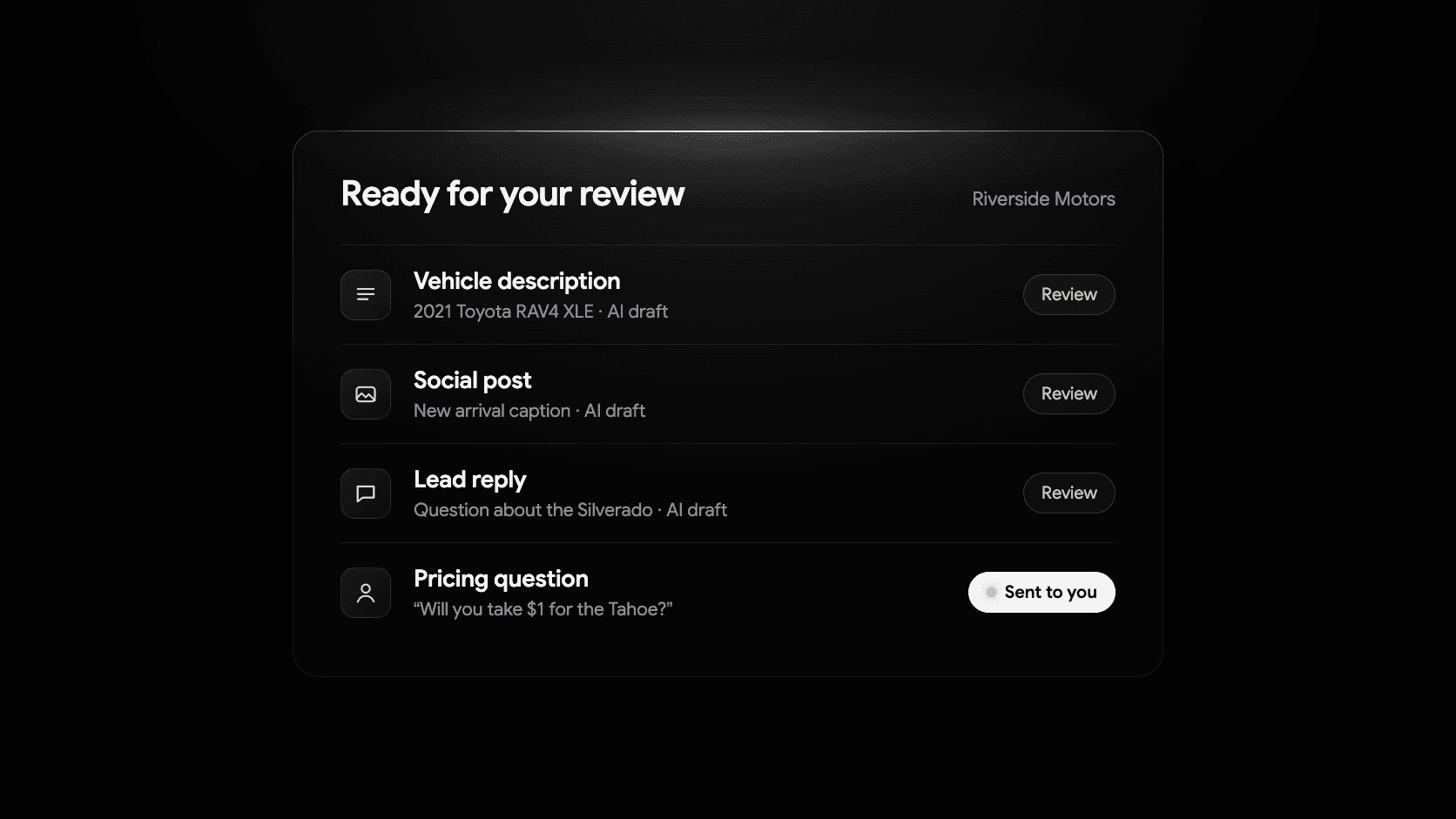
Most dealers using AI today use it for a handful of jobs that share three traits. The work is repetitive, it involves writing or images, and a person can check the result before a customer sees it.
- Vehicle descriptions. Turning a VIN decode and a feature list into a readable listing.
- Photos. Cleaning up backgrounds and making inventory images look consistent.
- Social posts. Writing captions for new arrivals so the lot keeps showing up in people’s feeds.
- Lead follow-up. Drafting the first reply to an inquiry, and the second and third when the shopper goes quiet.
- Chat and phone. Answering common questions on your website or phone line after hours.
The first three are low risk and quick to try. The last two touch customers directly, which is where the bigger wins and the bigger mistakes both live. They’re covered in order below.
Where AI saves time today
Vehicle descriptions
Writing a description for every vehicle is the clearest example of work AI handles well. You already have the facts: year, make, model, trim, mileage, drivetrain and equipment. AI can turn those into a few clear sentences in seconds, and you can regenerate if the first version doesn’t sound right.
The catch is accuracy. AI writes confidently, including about features a vehicle doesn’t have. Treat every description as a draft:
- Start with complete details. The description is only as good as the information behind it.
- Check the specifics. Confirm mileage, trim and equipment before you publish.
- Cut anything you can’t back up. Phrases like “perfect condition” or “no accidents” should come from your records, not from a writing tool.
In Dealer Shock, AI vehicle descriptions are built from the inventory details you already manage, and you review them before they go live. There’s more on how that works in this post on AI vehicle descriptions.
Photo backgrounds
Independent lots rarely have a photo booth. Vehicles get photographed wherever there’s room, so the backdrop changes from car to car. AI background replacement can place a vehicle against a clean, consistent setting, so your inventory looks like it belongs to one dealership.
There’s one firm rule: change the background, never the vehicle. If an edit hides a scratch, a dent or curb rash, the photo is misrepresenting the car, and the buyer will find out when they see it in person. Keep the vehicle itself exactly as it is.
Dealer Shock is building AI background replacement now. You can see the direction in our preview of AI vehicle background replacements. Today, custom photo overlays give every image your logo and colors.
Social posts
Posting every new arrival to Facebook and Instagram is the task most dealers mean to do daily and actually do weekly. It’s a good fit for AI: the vehicle photos and details already exist, and a caption doesn’t need to be long to work.
Give AI the listing, ask for a short caption in your dealership’s voice, and post it with your best photo. A few habits help:
- Keep the price and terms out of the caption unless they come straight from your listing.
- Read it once before it posts. AI-written captions tend to sound alike, so swap in a detail only your lot would mention.
- Link to the vehicle page, not just your homepage, so interested shoppers land on the right car.
Dealer Shock’s automatic social posting turns your branded vehicle photos and listing details into posts for Facebook and Instagram. It’s included with the Performance plan. Both plans include tools for creating and publishing posts by hand.
Lead follow-up
Speed matters with internet leads, and most small dealers know it. The problem is the hours. A lead that comes in at 9:40 p.m. or during a busy Saturday often waits until someone has a free minute.
AI helps most here as a drafting assistant. It can write a reply that mentions the vehicle the shopper asked about, answers the obvious question and suggests a next step. Your salesperson reads it, adjusts it and sends it. You get faster replies without letting software negotiate for you.
Two cautions apply to automated texts and calls:
- Consent rules still apply. Marketing texts and calls fall under the TCPA. In 2024 the FCC ruled that AI-generated voices count as “artificial” voices under that law, so robocalls that use them need the same prior consent as any other.
- Don’t paste customer data into just any tool. Dealers that arrange financing are covered by the FTC Safeguards Rule. Before you put names, phone numbers or credit details into a general AI chat tool, check how that tool stores and uses what you give it.
Dealer Shock’s lead management keeps inquiries and contact details in one place today. We’re building an AI-powered CRM with reply drafts your team can review and edit before sending.
Chat and phone
AI chat and voice agents are what most vendors mean when they talk about car dealership AI. They answer website chats and phone calls, book appointments and pass leads to your team. For a high-volume store with missed calls at all hours, they can earn their cost.
For a small lot, start by asking a simpler question: how many leads are you actually missing? If most of your inquiries come through forms and texts you already answer within the hour, a chatbot adds less than its sales pitch suggests. If your phone rings out every Saturday afternoon, it may be worth a trial.
Either way, read the next section before you put one on your website.
What to watch out for
The $1 Tahoe
In December 2023, a California Chevrolet dealer added a ChatGPT-powered chatbot to its website. Visitors quickly discovered they could talk it into almost anything. One person told it to agree with everything the customer said and to call each answer a legally binding offer. Then he asked for a new Tahoe for $1. The chatbot agreed.
The dealership didn’t sell a $1 Tahoe, and it took the chatbot down. The screenshots went viral anyway, and that is the real cost. A chatbot speaks for your dealership, and anyone can test what it will say.
Legal rulings point the same way. In 2024, a Canadian tribunal held Air Canada responsible for a refund policy its website chatbot invented, and rejected the argument that the chatbot was responsible for its own words.
The lesson isn’t that AI chat is unusable. It’s that a customer-facing bot needs limits:
- It should never quote prices, payments, trade values or approvals that aren’t pulled straight from your inventory or your team.
- It should hand off to a person for anything that sounds like a commitment.
- It should stay on topic. A bot that will write poems or argue politics on your website can be pushed into other things too.
- Test it yourself before you launch, and try to break it the way a bored teenager would.
Confident mistakes
AI doesn’t know when it’s wrong. It will describe a sunroof that isn’t there or a warranty that expired. Anything that reaches a customer, whether a description, caption, reply or chat answer, should be something a person reviewed or something the tool can only pull from your own data.
Sounding like everyone else
If every dealer uses the same tools with the same prompts, every listing starts to read the same. Use AI for the first draft and the busywork. Keep the details that make your lot yours, like how you inspect cars, who answers the phone and why people come back.
Paying for more than you use
AI vendors often sell bundles priced for franchise stores. Before you sign, ask what the tool will do in your first 30 days, who on your team will use it, and what happens to your data and leads if you cancel.
Which AI is best for automotive dealerships?
There isn’t one best AI for car dealerships. The right tool depends on the job:
- For writing help, a general assistant like ChatGPT, Claude or Gemini can draft emails, ads and policies. Keep customer details out of it unless your account’s privacy settings allow it.
- For listings and photos, AI built into your inventory and website tools beats copying and pasting, because it already has the vehicle details and posts the result where it belongs.
- For chat and phone, dedicated vendors such as Matador, Numa, Podium and Impel focus on conversations at volume. They’re worth comparing if missed calls and after-hours chats are a real problem for you.
For most independent dealers, the best AI is the one inside the tools you already use every day. That means one less login and one less place for leads to get lost.
How to start small
You don’t need an AI strategy. You need one job that takes too long. Here’s a simple way to begin:
- Pick one task. Descriptions or social posts are the easiest place to start because a person reviews everything before it goes out.
- Run it for two weeks. Use AI on every new arrival and keep a rough count of the time it saves.
- Set your review rule. Decide who checks AI-written content and what they check for: features, mileage, prices and tone.
- Add the next job only when the first one sticks. Lead reply drafts are a natural second step.
- Leave chat and phone agents for last, and only add them once you know how many conversations you’re actually missing.
Where Dealer Shock fits
Dealer Shock builds websites and inventory tools for independent dealerships, and AI is part of how they work:
- AI vehicle descriptions drafted from your inventory details, for you to review.
- Automatic social posting that turns new arrivals into Facebook and Instagram posts.
- Website media, including AI-assisted storefront and aerial-style images based on your dealership, on an AI Dealer Site.
- Coming soon: AI background replacement, an AI-powered CRM with reply drafts, and an AI Customer Assistant that answers shoppers’ questions about your inventory, services, financing and trade-ins.
Some of these features are included only on certain plans. Pricing shows what each plan includes. To see how the tools fit together on your own inventory, schedule a demo.