
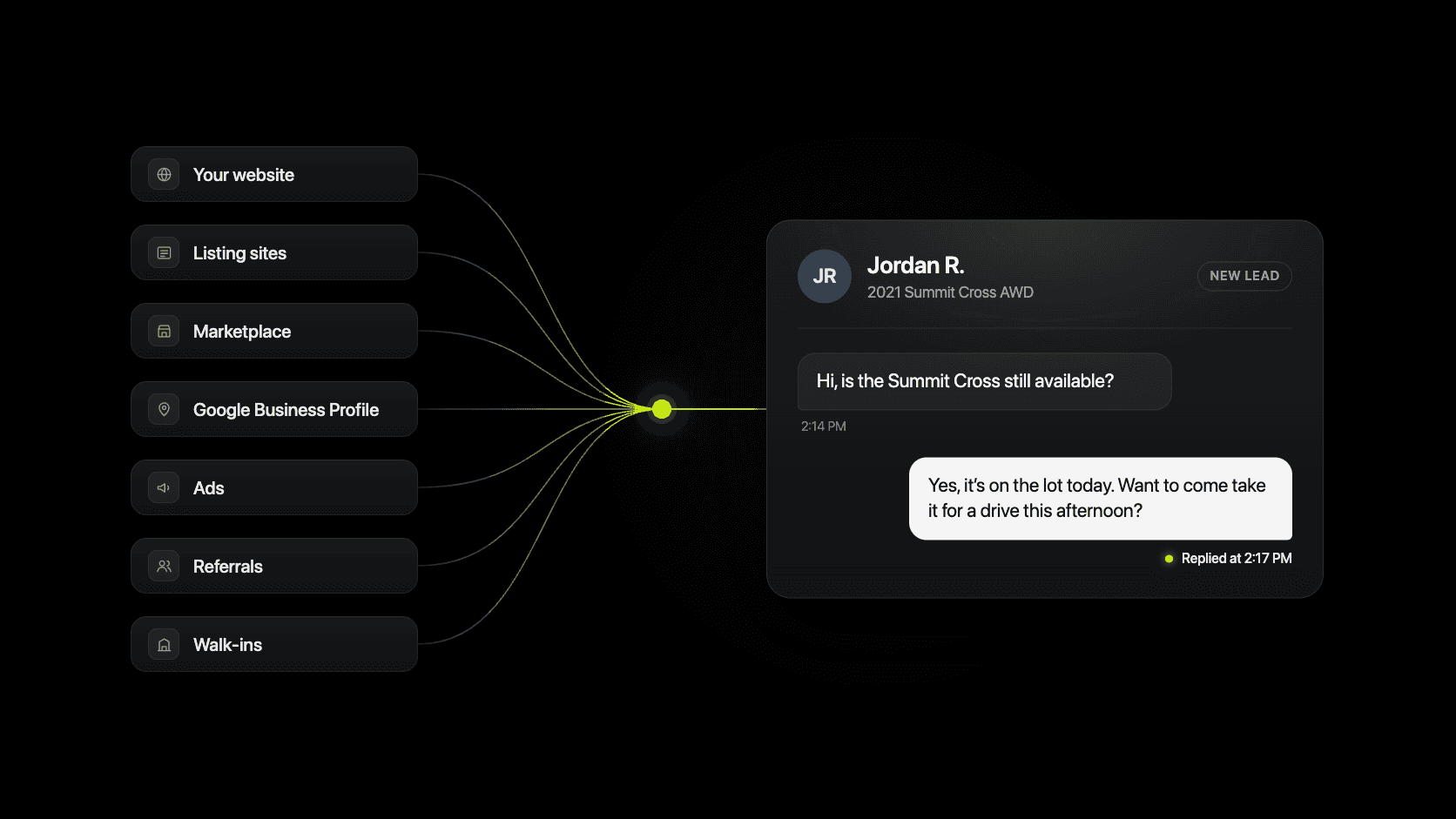
Most independent dealers don’t have a lead problem so much as a lead sorting problem. Inquiries arrive from five or six places, in five or six formats, and some get a reply in minutes while others sit until tomorrow.
Car dealership lead generation is worth working on. But before you buy more leads, it helps to know where your current ones come from, what each source really costs, and how quickly your team answers them. That last part usually matters most.
Car dealership lead sources: where leads come from
Every lot’s mix is different, but most independent dealers draw from the same handful of sources.
Your own website
Your website is the one lead source you fully own. Shoppers who contact you there have already chosen your dealership: they browsed your inventory, looked at a specific vehicle, and decided to ask you about it.
Website leads tend to arrive through a few forms: vehicle inquiries, test drive requests, trade-in requests and finance applications. Each one tells you something different about where the shopper is in their decision, so it’s worth keeping them connected to the same person instead of treating them as separate entries.
What to watch: how many visitors reach a vehicle page, and how many of those start a form. A site that’s slow, hard to search or vague about pricing loses shoppers before they ever become leads.
Third-party listing sites
Listing marketplaces put your inventory in front of shoppers who are comparing cars across many dealers. They can send real volume, especially for common makes and price ranges.
The trade-off is that these shoppers are often comparing several of your competitors at once, and many listing sites charge by subscription or by lead. A listing lead is a shopper who liked a car, not necessarily your dealership. Your reply has to do the work of earning the second conversation.
Facebook Marketplace
For many used-car lots, Marketplace is one of the busiest sources of conversations. Shoppers browse it casually, message quickly and expect quick answers.
Marketplace conversations are often short and informal (“Is this still available?”), so the quality varies widely. The dealers who do well here reply fast, answer the actual question, and move the conversation toward a call or a visit.
Google Business Profile
When someone searches for a used car dealer near them, your Google Business Profile is often the first thing they see. Calls, direction requests and website clicks from your profile come from people who are already close by and looking.
Keep your hours, photos, phone number and website link up to date, and ask happy buyers for reviews. It’s free, and for local shoppers it often matters as much as your website does.
Paid advertising
Ads on Facebook, Instagram and Google let you reach shoppers who haven’t found you yet: people in your market who are browsing, comparing, or searching for a vehicle like the ones on your lot.
Advertising doesn’t create leads on its own. It sends shoppers somewhere, usually your website or a vehicle page, and that page has to do its job. The best ad campaigns and the best websites work as a pair.
Referrals, repeat buyers and walk-ins
These rarely show up in a marketing report, but for many independent dealers they’re the best leads on the lot. A referral arrives with trust already built. A walk-in is standing in front of you.
The challenge is tracking them. If a walk-in found you through your website or an ad, you’ll only know if someone asks. A simple “How did you hear about us?” at the desk, written down every time, makes your other numbers far more honest.
How to compare lead sources by cost and quality
Volume is the easiest number to see and the least useful on its own. Fifty leads that never answer back are worth less than ten that come in to drive the car.
For each source, track these four things over a month or two:
- Total cost. Subscriptions, per-lead fees, ad spend and the time your team spends working those leads.
- Leads. How many inquiries the source actually produced.
- Conversations. How many of those leads replied, picked up the phone, or set an appointment.
- Sales. How many vehicles you sold to people who started with that source.
From there, two numbers tell you most of what you need:
- Cost per lead = total cost ÷ leads
- Cost per sale = total cost ÷ sales
A source with cheap leads and an expensive cost per sale is sending you volume, not buyers. A source with pricey leads and a reasonable cost per sale might deserve more of your budget, not less.
A few signs of a high-quality lead are worth noting as you go:
- They asked about a specific vehicle, not just “your best price.”
- They gave a real phone number or email and answered when you reached out.
- They looked at more than one vehicle or came back to your site more than once.
- They started a finance application or asked about their trade.
None of this requires special software to begin. A spreadsheet with one row per lead and a column for the source is enough to show you which sources are pulling their weight.
Why speed to follow-up matters more than volume
Here’s the uncomfortable part of car dealership lead generation: most dealers lose more sales after the lead arrives than before it.
A shopper who sends an inquiry is often sending several. They’re on their phone, comparing a few cars, and they’ll usually keep talking to whoever answers first with something useful. If your reply arrives tomorrow morning, the conversation may already be happening somewhere else.
That’s why doubling your lead volume rarely doubles your sales. If your team can’t answer the leads you already have quickly, more leads mostly means more leads waiting.
What fast, useful follow-up looks like
- Reply quickly, every time. Set a standard your team can actually keep during business hours, and decide who covers evenings and weekends.
- Answer the question they asked. If they asked whether a car is available, say yes or no in the first sentence, then offer a next step.
- Give every lead an owner. When a lead belongs to “whoever sees it,” it often belongs to no one. A name next to each lead makes the next follow-up someone’s job.
- Know what they were looking at. “I see you were looking at the white SUV and our financing page” is a better opener than “How can I help?”
- Follow up more than once. Many shoppers don’t answer the first message. A second and third attempt over a few days, on a different channel if you have one, brings back a lot of leads that looked dead.
- Don’t drop the half-finished ones. A shopper who starts a finance application and leaves is still telling you something. They gave you their name and showed interest in a vehicle. That’s worth a call.
Putting it together with Dealer Shock
Dealer Shock is built to help independent dealers with both sides of this: bringing in more shoppers, and following up well once they reach out.
On the follow-up side, lead management groups website submissions by contact, so a shopper’s vehicle inquiry, test drive request, trade-in and finance application stay together instead of showing up as separate entries. You can assign each contact to someone on your team and give them a status, so everyone can see who owns the next step and where each conversation stands.
Before you reply, you can see what the contact explored on your site: the vehicles they viewed and for how long, their inventory searches and filters, the pages they visited, and their conversations with your AI Customer Assistant. And when a shopper starts a finance application but leaves before submitting, Dealer Shock keeps the contact details and vehicle of interest they already provided and turns them into a lead your team can follow up with.
On the reach side, Managed Advertising is a campaign service for Facebook, Instagram and Google. Our team plans campaigns around your dealership, market and budget, using creative ads that tell your dealership’s story and inventory ads built from your vehicles. We manage and adjust the campaigns as they run, and it’s available with or without a Dealer Shock website.
Whatever tools you use, the order of operations is the same: know where your leads come from, measure what each source really costs, and make sure every lead hears back quickly. Once that’s working, adding more leads finally pays off.
Frequently asked questions
What is the best lead source for a used car dealership?
There’s no single best source. Referrals and repeat buyers usually close at the highest rate, and your own website tends to bring in shoppers who already chose your dealership. Listing sites and Marketplace can send more volume. Track cost per sale for each source to see which is best for your lot.
Should I buy car dealership leads?
Bought or per-lead sources can work, but compare them on cost per sale, not cost per lead. If your team is already slow to answer the leads you have, fix follow-up first. More leads won’t help if they wait.
How quickly should a dealership respond to a lead?
As quickly as you can with a useful answer, ideally within minutes during business hours. Shoppers often contact several dealers at once and keep talking to whoever replies first.