
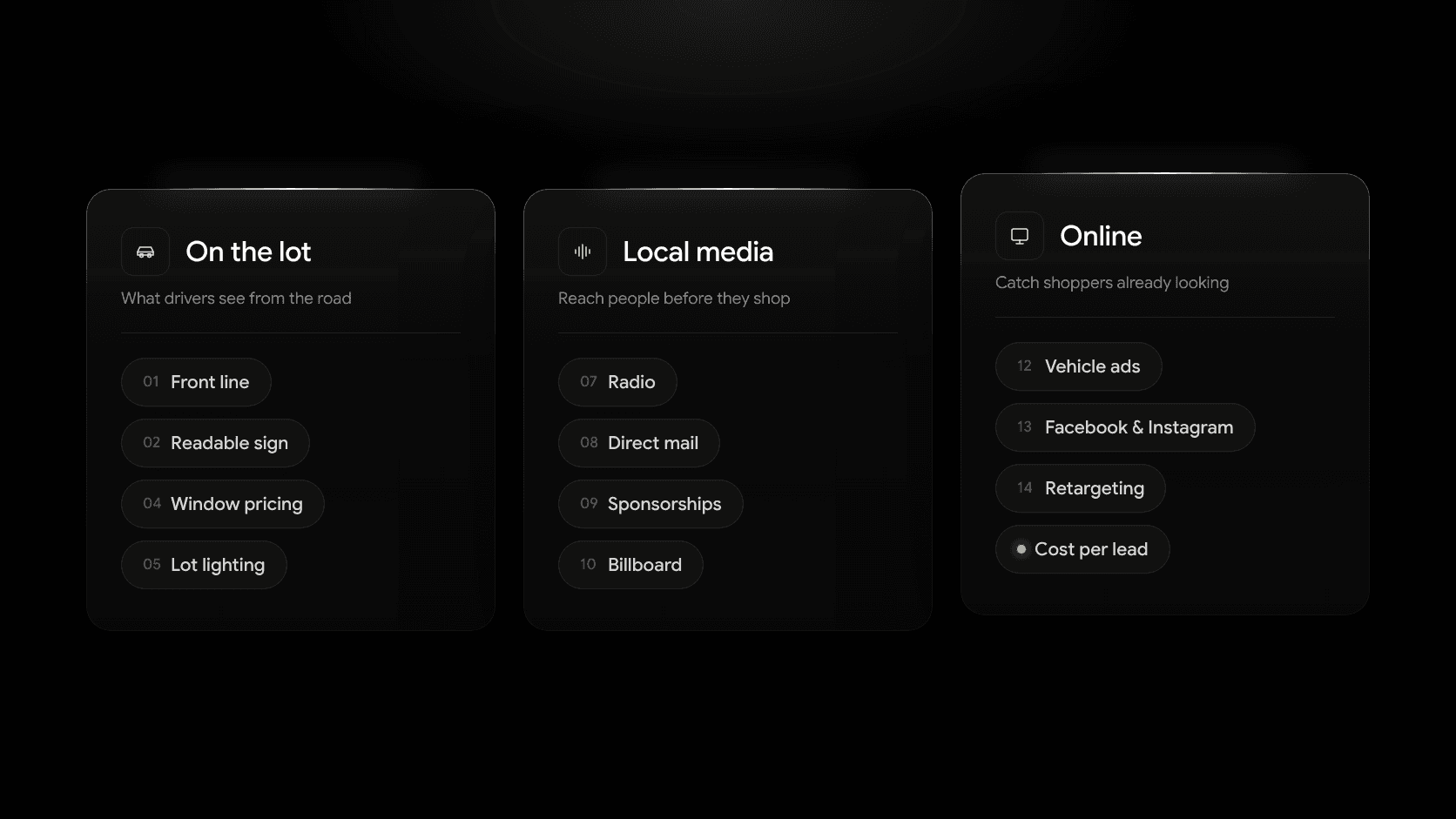
Advertising a used car lot is different from marketing one. Marketing is the steady work of good listings, reviews, and fast follow-up, which we covered in 12 used car dealership marketing ideas. Advertising is what you pay for or build so more people notice you in the first place: the lot itself, the sign out front, a radio spot, a postcard, an ad in someone’s feed.
Each of these fourteen ideas comes with when it suits a small independent lot and one way to tell whether it worked. An ad you can’t measure is a guess you keep paying for.
On the lot and outdoors
Your lot is the one ad you’re already paying for, so start here.
1. Treat the road-facing front line as your billboard
The row of vehicles nearest the road is what most passing drivers will ever see of your dealership. Put your most appealing, freshly detailed vehicles there, angled toward oncoming traffic, with a mix of body styles and colors so the row doesn’t read as one gray blur. Rotate it weekly so regular commuters see something new.
When it suits a small lot: always. It costs an hour of moving cars.
How to tell it worked: add “drove by” as an answer when you ask every walk-in how they heard about you, and note which front-line vehicle they asked about first.
2. Make the main sign readable at road speed
Drive past your lot at normal speed, both directions, and check whether you can read the dealership name and one more thing, such as “Used cars & trucks,” in the second or two you have. Fewer words and bigger letters often beat a new sign. Check your city or county sign rules and permit requirements before you replace or add one.
When it suits a small lot: when you’re on a busy road and your current sign is small, faded, or cluttered.
How to tell it worked: compare the share of “drove by” answers in the month before and after the change.
3. Use banners and flags for one message at a time
Flags and banners are cheap and easy to overdo. Give each banner one clear message, such as “Trucks and SUVs,” “Open Sundays,” or “Trade-ins welcome,” and change it when it stops being true or stops working. Many towns limit temporary signs, so confirm what’s allowed.
When it suits a small lot: when you want to tell drivers something your permanent sign doesn’t, like new hours.
How to tell it worked: run one message for two weeks, then another, and compare walk-ins who mention each.
4. Put readable pricing on every windshield
Windshield pricing readable from a few car lengths away turns every parked vehicle into its own ad. Keep it to year, model, price, mileage, and a QR code that opens the vehicle’s listing. Use the same price shoppers see online, and make it a price a buyer can actually pay (see the rules section below).
When it suits a small lot: always, especially if people browse while you’re closed.
How to tell it worked: point the QR codes at a dedicated landing URL or tracking tag so scans show up separately in your website analytics.
5. Light the lot for evening shoppers
In winter, a lot that goes dark at 5 p.m. disappears for the evening commute. Even lighting on the front line and sign keeps it working after hours and makes it feel safer to browse.
When it suits a small lot: if you’re on a commuter route, or you’ve seen people walking the lot after close.
How to tell it worked: watch QR scans after closing time and next-morning calls that start with “I stopped by last night.”
6. Lay out the lot so it’s easy to browse
Group vehicles the way shoppers think: trucks together, family SUVs together, commuter cars under a certain price together. Leave a clear walking path, keep visitor parking near the entrance, and make the office easy to find.
When it suits a small lot: when shoppers have to hunt, or walk-ins often leave without asking for help.
How to tell it worked: count test drives per week before and after the change.
Local paid media
Local media reaches people who aren’t shopping yet, so repeat one simple message long enough to be remembered. Give each channel its own phone number (call tracking services issue numbers that forward to your main line) or web address.
7. Local radio with a consistent message
Radio reaches commuters, the same people who drive past car lots. A live read by a local host often lands better than a produced spot, and consistency matters more than a clever script.
When it suits a small lot: when a station your buyers listen to exists and you can commit to a run of weeks, not a single burst.
How to tell it worked: read out a tracking number or a short web address you use only on radio, and count what it brings in.
8. Direct mail to the neighborhoods around your lot
A postcard puts your name in front of households close enough to drop by. The U.S. Postal Service’s Every Door Direct Mail delivers to every address on the carrier routes you choose, addressed to “Postal Customer,” so you don’t need a list of names. Keep the card simple: what you sell, where you are, and a few current vehicles.
When it suits a small lot: when most of your buyers come from a handful of nearby ZIP codes.
How to tell it worked: print a dedicated landing URL and tracking number on the card, and ask walk-ins whether they got it.
9. Local sponsorships
Sponsoring a Little League team, a high school scoreboard, or a county fair booth builds goodwill and keeps your name in front of local families. Treat it as reputation spending with a yearly cap.
When it suits a small lot: in small towns where people like buying locally.
How to tell it worked: put a short web address on the banner or program, and track “saw your sign at the game” in your how-did-you-hear answers.
10. A billboard on the route to your lot
A billboard makes sense on a road your buyers already drive, ideally a few minutes from the lot. Keep the message short: your name, one reason to visit, and directions such as “Next exit, right on Main.” They usually cost more than anything else here, so ask for traffic counts and the exact location before you sign.
When it suits a small lot: when your lot is just off a busy road but not visible from it.
How to tell it worked: use a phone number and web address you don’t use anywhere else, and compare your walk-in mix during the run with the months before.
11. Local print that your buyers still read
Community newspapers, free weekly shoppers, church bulletins, and Spanish-language or other community papers reach buyers that online ads can miss. They’re usually inexpensive.
When it suits a small lot: when you know your buyers read a particular local paper.
How to tell it worked: give each publication its own tracking number and compare cost per lead.
Online ads
Online ads reach shoppers who are already looking and come with built-in measurement. Make sure your listings are complete first, since every ad sends people to them.
12. Google vehicle ads
Google vehicle ads show a photo, price, mileage, and your dealership’s name at the top of searches like “used trucks near me,” and a click goes straight to that vehicle’s page. They need a Merchant Center account, a vehicle feed, and a linked Google Business Profile. Our guide to Google vehicle listing ads covers eligibility and setup.
When it suits a small lot: when your website has a page for each vehicle and your inventory system or website provider can send a feed.
How to tell it worked: track leads from vehicle pages as conversions in Google Ads, and divide spend by leads for cost per lead.
13. Facebook and Instagram ads that update from your inventory
Meta’s automotive inventory ads are built from a vehicle catalog, so the vehicles in your ads change as your inventory does. Meta’s catalog setup overview explains the options, including adding vehicles by hand for smaller lots. Target people within driving distance of your lot, not the whole state. These are paid ads, separate from free listings on Facebook Marketplace.
When it suits a small lot: when you have enough inventory for the ads to rotate.
How to tell it worked: watch cost per lead in Ads Manager, and tag these leads so you can tell them apart from Marketplace messages.
14. Retargeting shoppers who already viewed a vehicle
Retargeting shows ads to people who already visited your website or viewed a specific vehicle. Google and Meta both offer it once their tracking tag is on your site. Keep the audience recent and the frequency modest.
When it suits a small lot: once your website gets steady traffic. With few visitors, the audience is too small to run.
How to tell it worked: compare its cost per lead with your other online campaigns over the same 30 days.
If you’d rather not run the online side yourself, Dealer Shock, which publishes this blog, offers Managed Advertising: we plan and run creative and inventory ads on Facebook, Instagram, and Google, with a dashboard of clicks, leads, and spend.
Keep advertised prices and terms within the rules
On every channel, the prices, payments, and financing terms in your ads have to follow federal and state advertising rules. The FTC’s pricing transparency FAQs for the auto industry say the advertised price should be one any consumer can actually pay, excluding only government charges, and should be the most prominent price in the ad. Its post on advertising potholes for auto dealers describes problems with teaser payments, hidden balloon payments, and missing credit disclosures. States add their own rules. This isn’t legal advice; check windshield stickers, radio scripts, mailers, and ad templates with your state dealer association or an attorney.
Pick three and measure for 30 days
Trying everything at once hides what worked. Instead:
- Pick three ideas, one from each group. For example: rotate the front line weekly, mail one postcard drop, and run Google vehicle ads.
- Set up tracking before you start: a “how did you hear about us” question for every walk-in and caller, a tracking number or landing URL per paid channel, and lead tracking for online ads.
- Write down what you spend on each.
- After 30 days, work out cost per lead. Keep the best idea, adjust the middle one, and replace the weakest with another from this list.
Repeat monthly.
Frequently asked questions
What are the best car dealership advertising ideas on a small budget?
Start with the lot: a strong front line, a readable sign, windshield pricing with QR codes, and good lighting. Then add one paid channel you can measure, such as Google vehicle ads or one direct mail drop.
How do I advertise a used car lot outdoors?
Put your best vehicles facing traffic and rotate them weekly, keep your sign readable at road speed, run one banner message at a time, price every windshield, and light the lot after dark. Check local sign rules first.
What is the best advertising for a used car dealership?
Whatever brings leads at a cost you can afford in your market, and you only find that by measuring. Give each channel its own number or web address, ask every customer how they heard about you, and compare cost per lead after 30 days.