
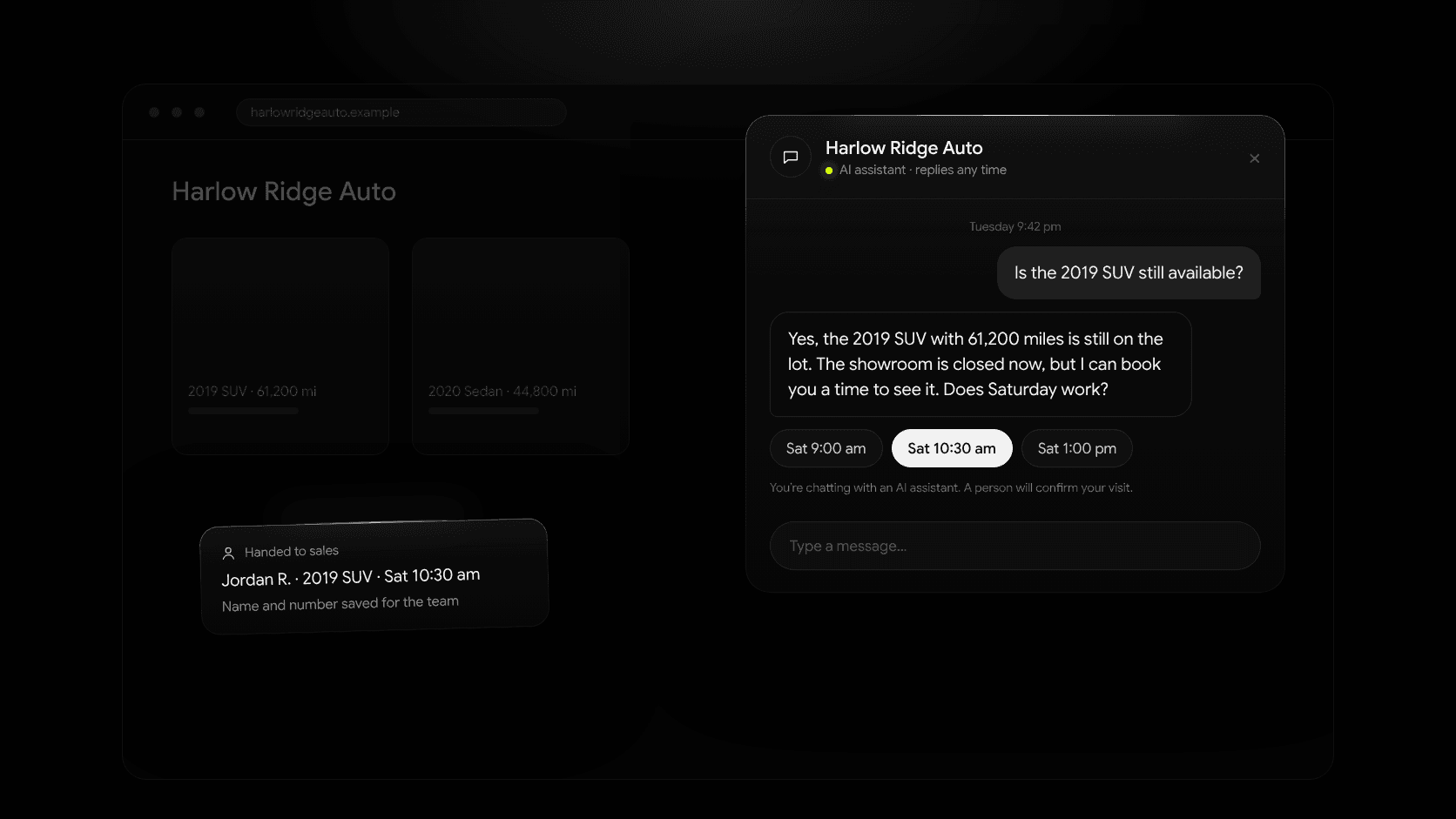
An AI chatbot for a car dealership is software on your website, and sometimes your text line or Facebook page, that answers shoppers’ questions in plain language at any hour. The useful ones read your live inventory, collect the shopper’s name and number, book a visit and pass the conversation to a person on your team.
That’s the whole idea. The rest of this guide covers what these tools do well, how the different labels compare, what vendors publish about price, and how to choose and test one without putting your reputation on autopilot.
A quick note on who’s writing. We make Dealer Shock, a website platform for independent dealers. Our Performance plan includes the AI Customer Assistant, which answers shoppers’ questions about your inventory, services, financing, trade-ins and your business, and lets you read every conversation. This guide covers what to look for in any chatbot, ours included. If you want the broader picture of AI at a dealership, including tools your staff use themselves, start with our guide to AI for car dealerships or AI for car salespeople. This post is about a different thing: a tool that talks to your shoppers directly.
What does a car dealership chatbot do?
Most dealership chatbots and AI sales assistants handle the same five jobs.
- Answer inventory and hours questions. “Is the 2019 SUV still available?” “Do you have anything under $15,000?” “Are you open Sunday?” A good one answers from your current inventory and your actual hours, not from a guess.
- Capture a name and number. The chat is only worth something if it ends with a way to reach the shopper. Most tools ask for a name, phone number or email once the shopper shows real interest.
- Book appointments. Test drives and visits, offered as specific times the shopper can pick.
- Reply after hours. Shoppers browse in the evening and on days you’re closed, when nobody is at the desk. An immediate answer at 9:42 pm is the main thing these tools offer that a small team can’t.
- Hand off to a person. When a shopper wants to negotiate, asks about credit or gets frustrated, the conversation should go to a salesperson, with the chat history attached.
What they shouldn’t do is the job of your sales manager: agree a price, promise an approval or make up details about a car.
Chatbot vs. AI sales assistant vs. virtual BDC
Vendors use these names loosely, and the lines between them move. Here’s what each usually means.
| Rule-based chatbot | AI chatbot or AI sales assistant | Virtual BDC | |
|---|---|---|---|
| Who answers | Software following a fixed script | Software that writes its own replies from your data | People working remotely, sometimes helped by AI |
| Handles unexpected questions | Poorly; it falls back to a menu or a form | Usually, within what it knows | Yes |
| Hours | Always on | Always on | Depends on the contract |
| Main risk | Shoppers give up on the menu | Confident wrong answers | Cost, and quality varies by agent |
| Typical channels | Website chat | Website chat, text, social messages, sometimes phone | Phone, text, email, chat |
“AI sales agent” and “AI assistant” are often marketing names for the middle column. Some products also follow up on leads by text and email for weeks, which takes them closer to a BDC. Ask which channels a product covers, not what it’s called.
How much does a dealership chatbot cost?
Many vendors don’t publish a price at all. The ones below do, as listed on their own sites on 26 November 2026. Prices are per store, per month, before taxes, and they change, so check the page before you budget.
| Vendor and product | Published price | Terms published |
|---|---|---|
| DealerCenter AI Sales Agent | $99 a month (pricing) | None stated |
| DealerCenter Website AI Agent | Not published (named on the same pricing page, no price) | None stated |
| DealerAI Chatbot | CA$599 a month per rooftop, including 5,000 credits (pricing) | Monthly billing, no setup fee, 30 days’ notice to cancel; extra usage and taxes extra |
| CarEdge Assistant | From $500 a month, or $5,000 a year, per rooftop (embedded chat) | 3-month minimum, then monthly |
| DealersCloud AI Employee and Web Chat | Not published; priced by dealership size and usage (pricing) | Plans are monthly with no long-term contract; not stated whether that covers the AI add-ons |
| Dealer Shock AI Customer Assistant (ours) | Included in the Performance website plan, $299 a month (pricing) | Month to month, no setup fees |
A few things to notice. DealerCenter describes its AI Sales Agent as AI-powered lead response and lists it on the same page as its DMS and CRM, so ask whether it needs those to run. DealerAI prices in Canadian dollars and meters usage in credits, with higher plans for outbound follow-up and voice as add-ons. CarEdge says its assistant answers from live inventory and confirmed pricing and sends each completed conversation to your CRM.
Whatever the sticker price, add the costs around it: setup, CRM integration, extra messages or minutes, and the time someone on your team spends reading transcripts each week.
Ten questions to ask before you buy
- Does it read your live inventory? Ask where its vehicle data comes from: your website feed, your DMS or a file someone uploads.
- How fast does it learn a car sold? If a car sells at 2 pm, when does the chatbot stop offering it? Ask for the actual refresh interval, in minutes or hours.
- Who can read the chats? Find out where transcripts are stored, who at the vendor can see them, how long they’re kept and whether they’re used to train anything.
- How do leads reach your CRM? Ask whether it creates a lead in your CRM or lead management tool directly, sends an email, or keeps leads in its own dashboard. Ask to see a lead arrive during the demo.
- What does it say when it doesn’t know? Ask a question it can’t answer. The right reply is “I’ll have someone confirm that,” not an invention.
- Can it quote prices or payments? Decide whether you want it to. If it can, ask where those numbers come from and whether you can switch it off.
- What are the contract and cancellation terms? Minimum term, setup fee, notice period and what happens to your chat data when you leave.
- Which languages does it handle? If many of your shoppers speak Spanish, test it in Spanish.
- How does it handle texting consent? If it texts shoppers, ask how it records consent and handles “STOP.”
- Who is responsible for what it says? Read the contract. If it promises something you can’t deliver, the shopper will hold your dealership to it, not the vendor.
Risks, and how to limit them
Wrong prices and wrong cars. An AI tool can state an old price or describe a feature a car doesn’t have, and it will sound sure of itself. Limit this by connecting it to your live inventory, keeping price and payment answers to what’s on your listing, and reading transcripts every week during the first month.
Promises a salesperson wouldn’t make. “Everyone gets approved.” “We’ll take $2,000 off.” Write down what the tool may never say: no approvals, no discounts, no trade values, no delivery dates. Then test those limits yourself before it goes live.
Shoppers not knowing they’re talking to AI. We recommend telling them, every time. A short line such as “You’re chatting with an AI assistant; a person will confirm your visit” costs nothing and avoids a shopper feeling misled when a different voice calls back.
Texting consent. Under the Telephone Consumer Protection Act, the FCC treats text messages like calls, and automated messages generally need the shopper’s prior consent. In a 2024 ruling, the FCC also confirmed that AI-generated voices count as “artificial” voices, so AI phone calls need the same consent as any robocall. Read the FCC’s declaratory ruling for the details, and ask your attorney how the rules apply to your follow-up. This guide isn’t legal advice.
How to trial a chatbot for 30 days
Ask for a 30-day trial or a short first term. Then treat it like any other lead source.
Before it goes live:
- Write down your current numbers for the last 30 days: website leads, appointments set and appointments that showed.
- Give it your hours, your policies and the list of things it may never say.
- Have two people on your team spend an evening trying to trip it up.
During the trial, track:
- Conversations that became leads. How many chats ended with a name and a phone number or email?
- Appointments booked, and how many showed. A booked appointment that doesn’t show isn’t worth much.
- After-hours leads. These are the ones you weren’t getting before.
- Handoff speed. How long between the chatbot handing off and a person replying?
- Wrong answers. Count every transcript where it got a fact wrong or overpromised. One a week is a warning; one a day means stop.
- Your team’s time. Hours spent reviewing chats and fixing leads.
At the end, compare against your baseline. If it added leads you weren’t getting and your team trusts its answers, keep it. If you can’t tell the difference, the money is probably better spent on lead generation or on answering the leads you already have faster.
Frequently asked questions
What is a car dealership chatbot?
A car dealership chatbot is software on a dealer’s website or text line that answers shoppers’ questions automatically. AI versions write their own replies from the dealer’s inventory and information, collect contact details, book appointments and hand conversations to staff.
How much does a dealership chatbot cost?
Vendors that published prices in November 2026 included DealerCenter, whose AI Sales Agent is $99 a month; CarEdge, whose assistant starts at $500 a month per rooftop; and DealerAI, whose Chatbot plan is CA$599 a month per rooftop. Many vendors don’t publish prices, and setup, integration and usage charges can add to the total.
What’s the difference between AI and a chatbot for car dealers?
An older chatbot follows a fixed script of buttons and menus. An AI chatbot, often sold as an AI sales assistant, writes its own answers to whatever the shopper types, using your inventory and dealership information. It’s more flexible, but it needs checking, because it can be confidently wrong.
Does AI chat work for car dealers?
It can, mostly by answering questions and booking visits outside business hours. Whether it works for your dealership depends on how many leads you miss today and how well it reads your inventory. Run a 30-day trial against your current numbers before you sign a long contract.