
If you want to sell used cars as a business, you’ll need a dealer license. Selling your own car now and then is one thing. Once you’re buying vehicles to resell, a license is how you do it legally. It’s also what gets you into dealer-only auctions.
So how do you obtain a dealer license? The process looks similar from state to state. The details, including fees, bond amounts, and location rules, are set by each state, so this guide explains the general process, shows real examples from several states’ official pages, and points you to where to confirm the rules for yours.
This is general information, not legal advice. Your state’s licensing agency is the final word, and requirements change. Check its current forms before you file.
Who issues dealer licenses
In most states, dealer licenses come from the DMV or a similar motor vehicle agency. Not every state works that way. The examples in this guide come from:
- California: California DMV, Vehicle Dealer License
- Texas: Texas Department of Motor Vehicles, Independent (GDN) License
- Florida: Florida Department of Highway Safety and Motor Vehicles, dealer licenses
- Georgia: Georgia Secretary of State, Used Motor Vehicle Dealers
If you’re in another state, search for your state’s name with “dealer license” and look for a result on an official .gov site. Your state’s independent auto dealers association is also a good place to ask questions.
Pick the right license type
Most states offer several dealer license types. Common ones include:
- Retail used vehicle dealer, for selling used vehicles to the public. This is the license most independent lots need.
- Wholesale dealer, for buying and selling only to other dealers. These often have lighter location requirements.
- New vehicle dealer, which requires a franchise agreement with a manufacturer.
- Specialty licenses for motorcycles, trailers, RVs, or salvage.
Texas, for example, calls its license a General Distinguishing Number (GDN) and issues it by category, such as independent motor vehicle, motorcycle, or wholesale.
How to get a car dealer’s license, step by step
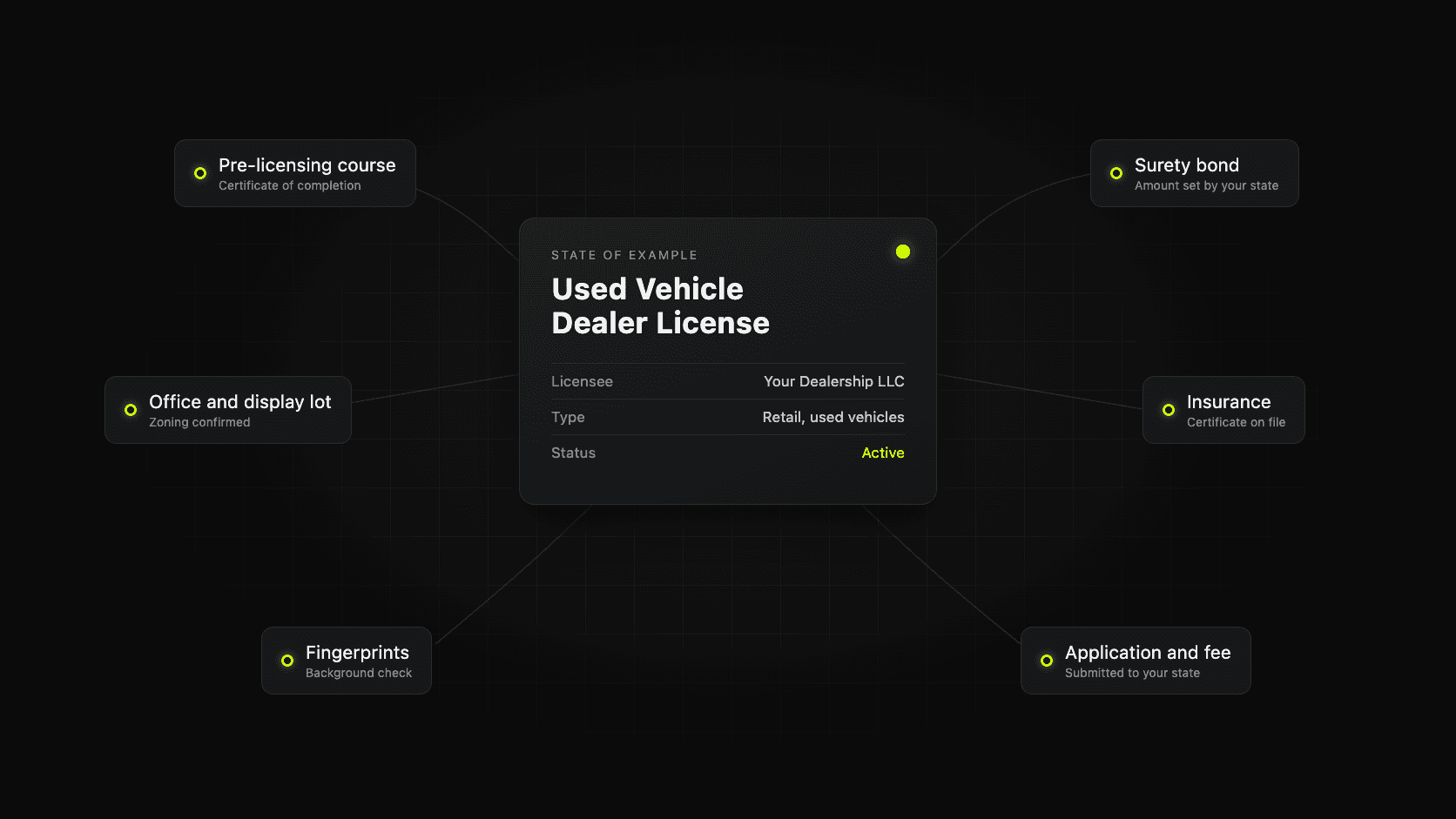
The order varies by state, but most applications ask for the same pieces.
1. Form your business
Register your business entity with your Secretary of State, get an EIN, and register for sales tax. States commonly ask for proof of each. California lists a seller’s permit from the California Department of Tax and Fee Administration among its requirements, and Florida asks for a sales tax number, an FEIN, and proof of business name registration.
2. Complete pre-licensing education
Many states require an approved course before you apply.
- California requires a certificate from a DMV-approved dealer education program and a passing score on a DMV-administered test.
- Texas requires a certificate from a TxDMV-approved licensing education course for motor vehicle GDN applicants.
- Florida requires a pre-licensing class from an approved dealer training school, with the certificate submitted with your application.
- Georgia requires a board-approved pre-licensing seminar before you apply.
3. Secure a qualifying location
Retail dealers usually need an established place of business, and the state may inspect it. Requirements often include a permanent office, a display area, a permanent sign, and records kept on site. Texas’s new application checklist, for example, asks for photos of an office with at least 100 square feet of floor space, a desk, and at least two chairs; a display area big enough for at least five vehicles; and a permanently mounted business sign that isn’t a banner.
You’ll also need to meet local zoning rules. Florida’s application requires you to meet local zoning and occupational license requirements, Georgia’s includes a zoning certification, and Texas asks you to confirm that any required zoning certification has been obtained. Confirm zoning with your city or county before you sign a lease.
4. Get a surety bond
Most states require a dealer surety bond, which protects customers if a dealer fails to deliver a title or commits fraud. We list examples of required amounts below.
5. Get insurance
Some states require proof of insurance with your application. Florida requires garage liability insurance with at least $25,000 of combined single-limit coverage and $10,000 of personal injury protection, and Georgia asks for a certificate of insurance.
6. Submit fingerprints and background information
California, Texas, Florida, and Georgia all require fingerprints or a background check for the people listed on the application. Be complete when answering criminal history questions. Texas warns that failing to disclose criminal history can affect your application.
7. Apply, pay the fee, and pass any inspection
California, Texas, and Georgia take applications through online portals, while Florida’s application goes to the regional office for your area. After you apply, expect a review and, in many states, a location inspection or site visit before the license is issued.
8. Keep it current
Dealer licenses must be renewed, usually every year or two. Some states require continuing education to renew. California requires used dealers to complete continuing education every two years, and Georgia requires six hours of continuing education to renew.
How much is a car dealer’s license?
The total cost of getting a dealer license is more than the application fee. Plan for:
- The state application fee
- Pre-licensing course tuition and any exam fee
- Your surety bond premium
- Fingerprinting fees
- Dealer plates, if you want them
- Insurance
- Your location: rent, signage, and any build-out needed to meet state rules
Some examples of state fees, from each agency’s official pages and forms:
- California: a $175 non-refundable application fee, a $16 examination fee, and $92 for each dealer plate, plus other fees that may apply.
- Texas: TxDMV’s eLICENSING guide lists $700 for each GDN license category and $90 for each metal dealer plate.
- Florida: a $300 application fee for motor vehicle dealers, listed on the license application.
- Georgia: fees are listed on the Secretary of State’s current fee schedule.
These figures come from each agency’s pages and forms at the time of writing. Confirm current fees with your state before you pay.
How much is a dealer bond?
Each state sets the bond amount. Some examples:
- California: $50,000, under Vehicle Code section 11710.
- Texas: $50,000 for most motor vehicle GDN holders.
- Georgia: $35,000 for used motor vehicle dealers.
- Florida: $25,000, or an irrevocable letter of credit.
You don’t pay the full bond amount. A surety company charges you a premium that’s usually based on your credit and the bond amount. Get quotes from more than one bond agency.
How long it takes
Timelines depend on your state and on how complete your application is. Missing documents are the most common cause of delays. Georgia, for example, notes that incomplete applications may be withdrawn if deficiencies aren’t resolved within 60 days.
You can shorten the wait by starting the slow pieces early: book your pre-licensing course, confirm zoning, and get bond and insurance quotes while you look for a location.
After you’re licensed
Your license lets you buy at dealer auctions, assign titles, and sell to the public. It doesn’t bring in customers. Most shoppers will look you up online before they visit, so plan your website, Google Business Profile, and first inventory alongside your license application.
Dealer Shock builds and launches websites for independent and used car dealers with no setup fees, including inventory syncing and lead management, so your site can be ready when your license is. For the rest of the opening checklist, from floor plan financing to auctions, see how to start a used car dealership.