
If you run a used-car lot, “hosting” probably sounds like something your web person handles. But your host decides how fast your site loads on a shopper’s phone, whether it stays up on a Saturday, and whether you can take your site with you if you leave.
This guide explains what hosting means for a dealership website, the two ways to get it, what to ask before you sign, and what it costs. We make one of the products mentioned here, Dealer Shock, so read that part with that in mind. Prices come from each company’s own pricing page, linked below, and were checked on November 26, 2026. They change often, so confirm them before you buy.
What “hosting” means for a dealer website
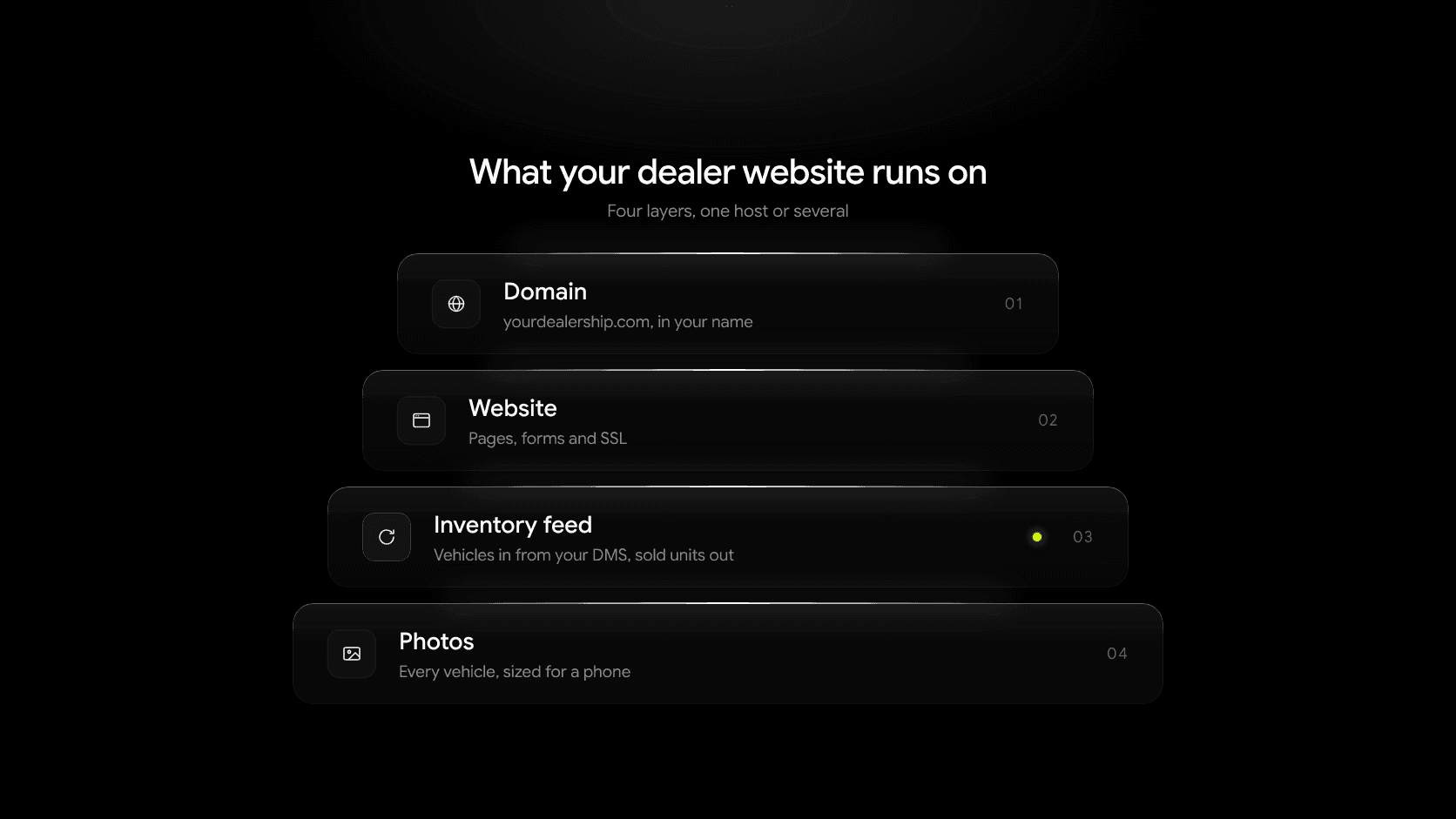
For most small businesses, hosting just means renting space on a server for a few pages. A dealership site has more moving parts:
- The website itself. The pages, the design, and the forms shoppers fill out. This is what a general web host stores and serves.
- The inventory feed. Your vehicles have to get from your DMS or inventory tool onto the site, with prices and details, and sold units have to come off. Someone has to run and maintain that connection.
- Vehicle photos. A lot with 60 cars and 30 photos each has close to 2,000 images. They need to be stored, resized for phones, and loaded quickly, or your vehicle pages crawl.
- The domain name. Your web address, like yourdealership.com. It’s registered separately from hosting, usually for a small yearly fee, and it should be in your dealership’s name.
Email is separate. Your @yourdealership.com inbox usually runs through a different service, such as Google Workspace or Microsoft 365, even if it uses the same domain. When you change website hosts, make sure nobody changes the settings that keep your email working.
The two ways to host a dealer website
Route 1: general web hosting, plus a site you build
You rent hosting from a company like Bluehost or Hostinger, then build the site yourself or pay someone to build it, often on WordPress. The hosting is cheap. Everything else is on you: installing updates, keeping plugins secure, and, most of all, getting your inventory onto the site. General hosts don’t import vehicles from your DMS. You’d need a dealer inventory plugin or a feed service on top, and someone to fix it when it breaks.
It can work for a small, slow-moving inventory and someone who likes technical work.
Route 2: a dealer website platform, with hosting included
Dealer website providers sell the site as a subscription. They run the servers, the inventory connection, and the photos, and you log in to manage vehicles and leads. You pay one monthly price instead of buying hosting separately.
You give up some control in exchange for not having to be your own IT department.
What to ask any host or provider
Whichever route you take, ask these before you sign:
- How fast is the site on a phone? Ask for a live dealer site they host and test its vehicle pages in Google’s free PageSpeed Insights. Look at the mobile results.
- What uptime do you promise, and what happens if you miss it? Some general hosts publish a guarantee with a credit attached. Ask for it in writing.
- How are backups handled? How often, how long they’re kept, and how quickly a broken site can be restored. On general hosting, check whether backups are included or an add-on.
- Is SSL included? SSL is what puts the padlock and “https” in the address bar. Browsers warn shoppers away from sites without it, and you don’t want that on a credit application.
- Who owns the domain? It should be registered to your dealership, with a login your business holds, not to the provider.
- What happens to my site and content if I leave? Ask whether you can export your pages, photos, and lead history, whether the design stays with the provider, and how long you have to move before the site goes dark.
What it costs
General web hosting
General hosts advertise low first-term prices that renew much higher, so look at the renewal price.
- Bluehost lists its Starter shared hosting at a regular rate of $13.79 a month, with a lower introductory price for the first term. Its listed plans include a free SSL certificate, weekly backups, and a free domain for the first year. (Bluehost shared hosting)
- Hostinger lists its Premium plan at a regular rate of $10.99 a month, with a lower introductory price when you pay for a long first term up front, with weekly backups, a free domain for the first year, and SSL listed among the protections on every plan. (Hostinger web hosting)
Both showed promotional prices when we checked, so expect first-term prices to move. And this is only the hosting. A site builder theme, an inventory plugin or feed, and someone’s time to build and maintain it all come on top.
Dealer website platforms
These are the published monthly prices for dealer-focused providers. Their pricing pages don’t itemize hosting, so ask each one to confirm it’s included and what it covers.
- Carsforsale.com: $99 a month for independent dealers, with no contracts and no setup fees. Dealers with 100 or more listings, and franchise dealers, start at $199. (Pricing)
- DealerCenter: $99 or $125 a month for its Premium and Premium Pro websites, sold as add-ons to its other products. Its DMS is listed separately at $99 a month. (Pricing)
- Dealer Shock: $199 or $299 a month per website. More below. (Pricing)
- DealerOn: $599, $899, or $1,199 a month for its Core, Premier, and Elite plans for independent dealers. (Independent dealer websites)
- Overfuel: no rate card, but its switch offer uses $950 a month as an example rate, with a 90-day minimum and then month-to-month terms. (Switch offer)
For setup fees, contracts, and the other costs that sit outside the monthly price, see our guide to car dealer website cost.
The two routes side by side
| General web hosting + a site you build | Dealer website platform | |
|---|---|---|
| Published monthly price | About $11 to $14 for hosting alone at regular rates; less on an introductory term | $99 to $1,199 for the whole site |
| Inventory feed | Not included; add a plugin or feed service | Built in, though some feeds may cost extra |
| Vehicle photos | You manage storage and sizing | Usually handled by the platform |
| Updates and security | You or your developer | The provider |
| SSL and backups | Listed on the plans we checked; confirm the details | Ask the provider |
| Domain | Often free for year one, then a yearly fee | Ask who registers it and in whose name |
| Leaving | You keep the files, but the work to move them is yours | Depends on the provider; ask before you sign |
Where Dealer Shock fits
Dealer Shock is a dealer website platform, so it’s Route 2. Our plans are a hosted website, and there is no separate hosting bill. Both plans list hosting and site management alongside the website, inventory management and syncing, and lead management.
- Starter, $199 a month: a professionally built, mobile-friendly website using the logos, photos, and videos you supply, plus general website analytics and tools for posting to social media yourself.
- Performance, $299 a month: everything in Starter, plus custom branding and website media, vehicle and contact insights, AI vehicle descriptions, automatic social posts, Local Reach pages, and the AI Customer Assistant.
There are no setup fees and no contracts. If you cancel, your site stays up through the month you’ve already paid for. If you’re not satisfied, you can ask for your most recent monthly payment back, and that applies every month you’re subscribed.
Dealer Shock isn’t a DMS, so you’ll keep your current system for deals and accounting. We’re not part of any OEM website program, so if your franchise requires a certified site, we aren’t an option for that store. Ask us the same six questions above. You should get straight answers from any provider, including us.
Frequently asked questions
What is car dealer website hosting?
It’s where your dealership site lives: the server for your pages, the connection that keeps your inventory current, and the storage for your vehicle photos. Your domain name and email are usually separate.
How much does auto dealer web hosting cost?
General web hosting starts at a few dollars a month for the first term and renews at roughly $11 to $14 a month on the plans we checked, but it doesn’t handle inventory. Dealer website platforms, where hosting comes with the site, publish prices from $99 to $1,199 a month.
Do used car dealer website providers include hosting?
Dealer website platforms run the site for you, so you don’t buy hosting separately. Not every provider spells it out on its pricing page, so ask. Dealer Shock lists hosting and site management on both of its plans.
See your new site before you pay anything
The easiest way to judge a provider is to see your own dealership on it. Share your current site, and we’ll build a free website preview within 24 hours. No credit card, no contract. Or compare the plans on our pricing page.